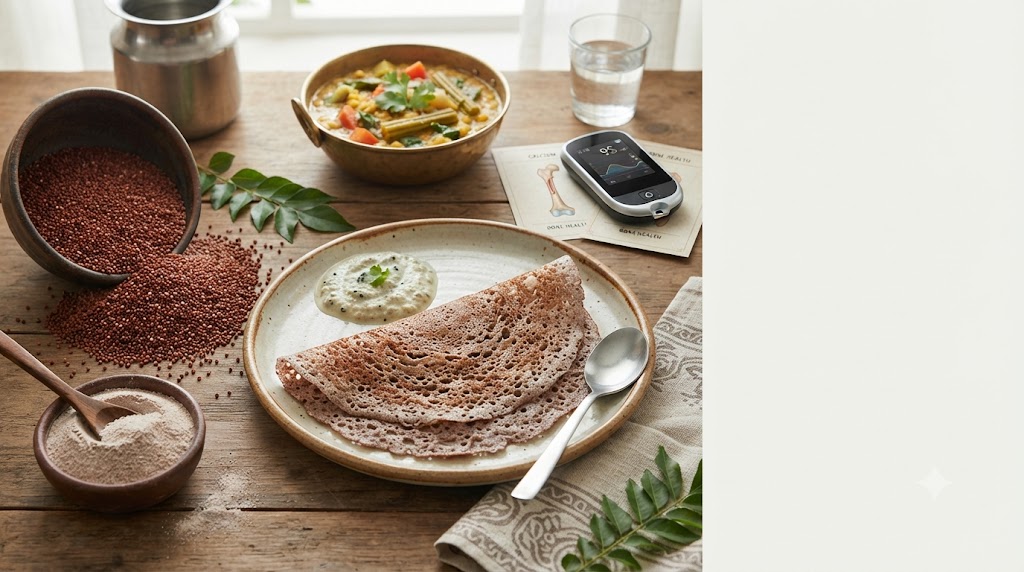
Ragi, also known as finger millet (Eleusine coracana), is a traditional cereal widely consumed in India and parts of Africa. In recent years, it has attracted attention as a potentially useful food for people interested in blood-sugar management, bone health, healthy aging and better nutrition.
Ragi is particularly interesting because it provides dietary fiber, calcium and other nutrients, while its carbohydrate profile and processing method can influence its effect on blood glucose.
But is ragi really a “diabetes-friendly” grain? Can it strengthen bones? And does eating ragi automatically make a diet healthier?
The scientific evidence provides some encouraging answers, but it also shows why portion size, preparation and the overall diet matter.


🌱 What Is Ragi?
Ragi is the common Indian name for finger millet, a small-seeded cereal traditionally cultivated in India.
Its tiny reddish-brown grains can be processed into flour and used to make:
- Ragi roti
- Ragi dosa
- Ragi mudde
- Ragi porridge
- Ragi idli
- Ragi malt
- Baked foods and snacks
One reason ragi has become popular among health-conscious consumers is its nutritional density, particularly its calcium content.
Unlike refined grains, whole-grain ragi also provides dietary fiber and various micronutrients.
However, the nutritional value of a ragi-based meal depends on what else is included. A bowl of minimally sweetened ragi porridge is nutritionally different from a highly sweetened ragi beverage or a processed ragi snack.
🩸 Ragi and Blood Sugar: Why Is It Being Studied?
Diabetes management involves controlling blood glucose while maintaining adequate nutrition.
Because ragi contains complex carbohydrates and dietary fiber, researchers have investigated whether it produces a different glucose response compared with some refined cereal products.
The glycemic index (GI) is one measurement used to describe how quickly carbohydrate-containing foods raise blood glucose.
However, GI should not be treated as a complete measure of whether a food is suitable for diabetes.
The amount eaten also matters.
This is where glycemic load (GL) becomes useful because it considers both the carbohydrate quality and the amount consumed.
A relatively moderate-GI food eaten in a very large portion can still provide a substantial carbohydrate load.
🔬 What Does Research Say About Ragi and Diabetes?
Research on millets overall has produced encouraging findings.
Systematic reviews examining millet consumption have reported potential improvements in measures such as fasting glucose, post-meal glucose and HbA1c in some populations.
However, the evidence is not uniform, and studies often involve different millet varieties, preparation methods and participant groups.
That distinction matters because ragi is only one type of millet.
Some research on finger millet specifically suggests that its polyphenols, fiber and other components may influence glucose metabolism. But much of the evidence is based on small human studies, laboratory experiments or comparisons between particular food preparations.
Therefore, it would be inaccurate to say:
“Ragi lowers blood sugar in everyone with diabetes.”
A more appropriate conclusion is that ragi can potentially be incorporated into a diabetes-conscious diet, particularly when consumed as a minimally processed whole grain and in appropriate portions.
🌾 The Importance of Ragi’s Fiber
Dietary fiber is one of ragi’s nutritional strengths.
Fiber can influence digestion, intestinal transit and the absorption of carbohydrates.
When a carbohydrate-rich food contains more fiber and is eaten as part of a balanced meal, glucose may enter the bloodstream more gradually than with certain highly refined carbohydrate foods.
Ragi’s fiber content may therefore contribute to its metabolic appeal.
But fiber alone does not make a food “free” of blood-sugar effects.
Ragi is still a carbohydrate-containing grain.
That means portion size remains important, particularly for people managing diabetes.
🍚 Whole Ragi vs. Ragi Flour
The form in which ragi is consumed can influence its nutritional and metabolic characteristics.
Whole or minimally processed grains generally retain their original structure more effectively than highly milled products.
When ragi is ground into flour, the physical structure of the grain changes.
Cooking also changes starch characteristics.
For example, ragi porridge, ragi dosa and ragi roti can have different digestion characteristics depending on:
- Flour particle size
- Fermentation
- Cooking temperature
- Cooking duration
- Other ingredients
- Portion size
Therefore, “ragi has a low GI” is too simplistic.
The actual response depends on how ragi is processed, prepared and consumed.
🥣 Ragi Porridge and Diabetes
Ragi porridge is one of the most popular preparations.
It can be nutritious when prepared with:
- Ragi flour
- Milk or an appropriate alternative
- Nuts or seeds
- Spices such as cinnamon or cardamom
- Minimal added sugar
However, adding substantial amounts of sugar, jaggery, sweetened condensed milk or flavored syrups can dramatically change the nutritional profile.
A food does not become diabetes-friendly simply because its primary ingredient is ragi.
A better approach
Use ragi as the carbohydrate component and combine it with protein, healthy fats and fiber-rich ingredients.
For example, adding nuts or seeds can make the meal more filling and nutritionally diverse.
🥞 What About Ragi Dosa?
Ragi dosa can be part of a balanced meal.
Fermentation may alter the physical and chemical characteristics of the batter, while the addition of ingredients such as urad dal can increase protein content.


For someone managing blood glucose, portion size and accompanying foods remain important.
Ragi dosa served with vegetable-rich sambar can provide a more balanced meal than a large serving eaten alone.
🦴 Ragi and Bone Health
Blood sugar isn’t the only reason ragi attracts attention.
Ragi is particularly well known for its calcium content.
Calcium is essential for:
- Bone mineralization
- Teeth
- Muscle contraction
- Nerve signaling
- Normal cellular functions
Adequate calcium intake is important throughout life.
It is especially relevant during childhood and adolescence, when the skeleton is developing, and later in adulthood when maintaining bone mass becomes increasingly important.
🥛 Does Eating Ragi Make Bones Stronger?
This question requires some nuance.
Ragi provides calcium, but bone health is not determined by one food.
The skeleton requires multiple nutrients and lifestyle factors, including:
- Calcium
- Vitamin D
- Protein
- Phosphorus
- Magnesium
- Vitamin K
- Adequate energy intake
- Weight-bearing physical activity
Therefore, eating ragi regularly can contribute calcium to the diet, but it does not automatically prevent osteoporosis or fractures.
A balanced dietary pattern is more important than relying on one cereal.
🧬 Ragi’s Calcium: An Important Nutritional Advantage
Among commonly consumed cereals, finger millet is notable for its calcium content.
This makes it particularly interesting in dietary patterns where calcium intake may otherwise be low.
For example, a person who consumes limited dairy products may use ragi alongside other calcium-containing foods.
However, the amount of calcium actually absorbed by the body matters—not just the amount listed in a nutrition table.
This brings us to phytates.
🔬 Phytates and Mineral Absorption
Ragi contains naturally occurring compounds called phytates, or phytic acid.
Phytates can bind minerals such as calcium, iron and zinc and may reduce their absorption under certain conditions.
This does not mean that ragi is an unhealthy food.
Food processing methods such as:
- Soaking
- Germination
- Fermentation
- Cooking
can influence phytate levels and mineral availability.
This is one reason traditional food-processing practices are scientifically interesting.
🌱 Germinated Ragi
Finger millet can be germinated or malted before being processed.
Germination can alter the nutritional composition of the grain and may reduce certain antinutritional factors.
Research has investigated germinated millet products for possible improvements in nutrient availability and digestibility.
However, germinated ragi should still be considered one component of a balanced diet rather than a special therapeutic food.
💪 Ragi and Protein
Ragi contributes protein, although it should not necessarily be considered a complete protein source comparable with many animal proteins.
For people following vegetarian or plant-based diets, combining cereals with legumes can improve the overall amino-acid profile of meals.
Examples include:
Ragi + dal
Ragi dosa + urad dal
Ragi roti + lentils
Ragi meal + beans
This approach can make ragi-based meals nutritionally more complete.
🧓 Ragi and Healthy Aging
Bone health becomes particularly important with aging.
Age-related changes can contribute to reductions in bone density and muscle mass.
Nutrition therefore plays an important supporting role.
Ragi can contribute:
🌾 Complex carbohydrates
🌿 Dietary fiber
🦴 Calcium
💪 Some protein
🧬 Plant compounds
But healthy aging requires a much broader strategy.
Regular resistance and weight-bearing exercise, adequate protein, sufficient vitamin D and overall dietary quality are all important.
🩺 Can People With Diabetes Eat Ragi Every Day?
There is no universal rule that everyone with diabetes should or should not eat ragi every day.
Individual carbohydrate requirements differ.
Some people may comfortably include a moderate serving of ragi as part of meals, while others may need to adjust portions according to their glucose response.
A useful approach is to observe how a particular ragi meal affects blood glucose when appropriate and to discuss dietary adjustments with a healthcare professional or registered dietitian.
⚖️ Ragi for Weight Management
Ragi is sometimes marketed as a weight-loss food.
The reality is more nuanced.
Ragi contains fiber and can contribute to satiety, but no grain automatically causes weight loss.
Weight management depends on total energy intake, dietary quality, physical activity, sleep and other factors.
A calorie-dense ragi snack containing sugar, nuts, oil and large portions can provide considerably more energy than a simple serving of ragi combined with vegetables and protein.
Therefore, the phrase “healthy grain” does not mean “unlimited food.”
🍽️ How to Build a Diabetes-Friendly Ragi Meal
A practical meal could combine ragi with other food groups.
🌾 Carbohydrate
Ragi roti, ragi dosa or another appropriate ragi preparation.
🫘 Protein
Dal, beans, curd, eggs, fish, tofu or another suitable protein source.
🥬 Vegetables
Leafy greens, cauliflower, beans, carrots, tomatoes or other vegetables.
🥜 Healthy fats
Nuts, seeds or moderate amounts of healthy cooking oils.
This combination is generally more nutritionally balanced than relying on ragi alone.
🚫 Common Ragi Myths
Myth 1: Ragi Has No Effect on Blood Sugar
Reality: Ragi contains carbohydrates and can raise blood glucose. Its impact depends on the amount, preparation and overall meal.
Myth 2: Ragi Cures Diabetes
Reality: There is no evidence that ragi cures diabetes.
Myth 3: More Ragi Means Stronger Bones
Reality: Ragi can provide calcium, but bone health requires a combination of nutrients, exercise and other lifestyle factors.
Myth 4: Ragi Is Always Low GI
Reality: The glycemic response varies according to processing, cooking, meal composition and portion size.
Myth 5: Ragi Products Are Automatically Healthy
Reality: Processed ragi biscuits, sweetened drinks and snacks can contain substantial amounts of sugar, fat or calories.
🧪 What Researchers Still Need to Understand
Although millet research is expanding, several questions remain.
Future studies could examine:
- Long-term ragi consumption
- Standardized serving sizes
- HbA1c outcomes
- Post-meal glucose responses
- Ragi compared directly with other whole grains
- Different cooking methods
- Fermented versus non-fermented products
- Effects on bone mineral density
- Calcium absorption
- Effects in older adults
- Effects in people with type 2 diabetes
Long-term randomized trials would be especially useful.
🦴 Ragi and Bone Health: Beyond Calcium
Calcium is important, but bone is living tissue.
Bones continually undergo remodeling, with old tissue being removed and new tissue being formed.
Adequate nutrition supports this process.
☀️ Vitamin D
Vitamin D helps the body absorb calcium.
💪 Protein
Protein provides amino acids required for bone matrix and muscle maintenance.
🏃 Exercise
Weight-bearing and resistance exercises provide mechanical stimulation that supports skeletal health.
🥬 Micronutrients
Magnesium, phosphorus, vitamin K and other nutrients contribute to normal bone physiology.
Thus, ragi can be one component of a bone-supportive dietary pattern rather than a stand-alone bone supplement.
🌾 How Much Ragi Should You Eat?
There is no single scientifically established “diabetes dose” of ragi.
The appropriate serving depends on:
- Individual calorie requirements
- Carbohydrate tolerance
- Diabetes treatment
- Physical activity
- Age
- Overall diet
- Other health conditions
Instead of focusing on a magic quantity, focus on portion control and meal balance.
For someone with diabetes, a dietitian can help determine how ragi fits into the individual’s carbohydrate plan.
🧡 Is Ragi Better Than Rice or Wheat?
This question is often asked, but nutrition rarely works as a simple winner-versus-loser comparison.
Rice, wheat and ragi can all be part of healthy diets.
The important factors include:
- Whole versus refined grain
- Portion size
- Fiber content
- Processing
- Cooking method
- Meal composition
- Individual metabolic response
Replacing highly refined grains with more whole-grain foods may improve dietary quality, but the ideal grain depends on individual nutritional needs and cultural dietary patterns.
🌍 Why Ragi Matters in Indian Nutrition
Ragi has an important place in traditional Indian food culture.
It is particularly associated with parts of southern and central India, where dishes based on finger millet have been consumed for generations.
Its continued popularity illustrates an important principle in nutrition: traditional foods can provide valuable nutritional characteristics, but they should still be evaluated using modern scientific evidence.
Ragi doesn’t need to be presented as a “superfood” to be valuable.
Its naturally high calcium content and fiber contribution already make it an interesting grain.
🔎 The Bottom Line on Ragi and Diabetes
Current research suggests that millet-based diets may have favorable effects on several markers of glucose metabolism, but evidence specific to ragi varies according to study design and food preparation.
Ragi can be incorporated into a diabetes-conscious diet, especially when it replaces more refined carbohydrate foods and is eaten in an appropriate portion.
But ragi is still a carbohydrate.
Therefore:
Choose reasonable portions.
Prefer minimally processed preparations.
Combine it with vegetables and protein.
Limit added sugar.
Monitor individual glucose responses when appropriate.
🌟 The Bottom Line on Ragi and Bone Health
Ragi’s calcium content makes it a valuable food for people seeking to increase dietary calcium.
However, healthy bones require much more than calcium.
Adequate vitamin D, protein, physical activity and overall nutritional adequacy are essential.
Ragi can therefore be part of a bone-supportive diet, but it should not be viewed as a treatment for osteoporosis or a replacement for medically recommended interventions.
🌾 Final Conclusion
Ragi is a traditional grain with a modern nutritional story.
Its combination of calcium, dietary fiber, carbohydrates, plant compounds and other nutrients makes finger millet an interesting food for people concerned about diabetes, bone health and healthy aging.
Nutrition research suggests that millet-based dietary patterns may offer metabolic advantages, while ragi’s calcium content provides a genuine nutritional benefit. At the same time, scientific evidence does not support exaggerated claims that ragi can cure diabetes, automatically lower blood sugar or independently strengthen bones.
The healthiest approach is to treat ragi as one nutritious component of a diverse diet. 🌾🥗
For blood-sugar management, pay attention to portion size, processing and the rest of the meal. For bone health, combine calcium-rich foods with adequate protein, vitamin D and regular weight-bearing exercise.
Ragi doesn’t need to be a miracle food to be useful—it can simply be a nutritious traditional grain that fits well into a balanced modern diet. 💚