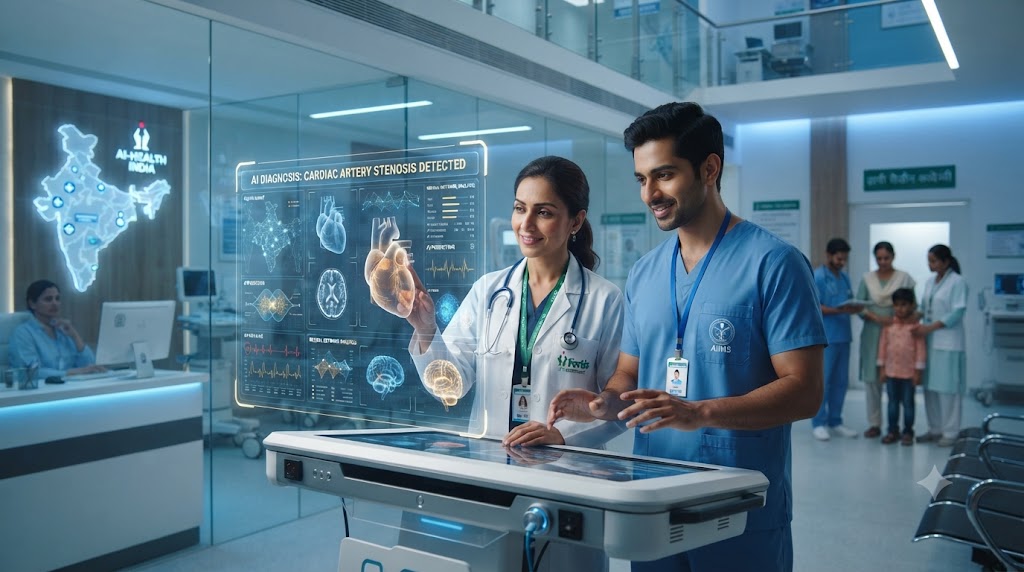
Discover how AI is transforming healthcare in India in 2026, from faster diagnosis and medical imaging to primary care, telemedicine, cancer screening, disease surveillance and personalized healthcare.
Introduction: India’s Healthcare System Enters the AI Era 🤖🇮🇳
Artificial intelligence is rapidly becoming part of the conversation around India’s future healthcare system. In 2026, the country’s focus is moving beyond experiments with individual AI tools toward questions of safe deployment, clinical validation, primary care, health data, medical imaging and equitable access.
India launched the Strategy for Artificial Intelligence in Healthcare for India (SAHI) in February 2026. The framework is designed to support safe, ethical, evidence-based and inclusive adoption of AI across the healthcare system. At the same time, the government launched BODH — Benchmarking Open Data Platform for Health AI — to help evaluate AI systems using diverse, real-world health data before wider deployment. (Press Information Bureau)
This development is significant because India’s healthcare challenges are enormous. The country has a huge and diverse population, significant rural and urban differences, uneven access to specialists and a growing burden of non-communicable diseases.
AI cannot solve all of these problems by itself. But properly designed systems could help healthcare professionals identify disease earlier, organise clinical information, support diagnosis, extend specialist capabilities and improve access to care.
The most important question is therefore not whether AI will enter Indian healthcare. It already is.
The more important question is how AI can be introduced safely, responsibly and in ways that genuinely improve patient care.


1. What Is AI in Healthcare? 🧠🩺
Artificial intelligence refers to computer systems that can perform tasks that normally require aspects of human intelligence, such as recognising patterns, analysing information, making predictions or assisting with decision-making.
In healthcare, AI can process different kinds of information, including:
🩻 Medical images
🧪 Laboratory results
📋 Clinical records
🧬 Genomic information
📊 Population-health data
⌚ Wearable-device data
🗣️ Medical conversations and text
Machine-learning systems can be trained using large datasets to identify patterns associated with particular diseases.
For example, an AI system might analyse an X-ray and highlight an area that requires a doctor’s attention.
This does not necessarily mean that the AI independently diagnoses the patient.
In many clinical applications, the intended model is AI-assisted healthcare, where a trained healthcare professional remains responsible for interpreting the information and making clinical decisions.
2. Why AI Matters Particularly for India 🇮🇳
India’s healthcare system has several characteristics that make AI potentially useful.
The country has a very large population, major geographic variation and significant differences in healthcare access between locations.
Specialists and advanced diagnostic facilities are not distributed equally across all regions.
This creates a potential role for technologies that can help extend healthcare expertise.
The Government of India’s 2026 AI healthcare framework specifically emphasises responsible, scalable and inclusive adoption, while WHO has highlighted AI’s potential to strengthen health systems and primary healthcare. (World Health Organization)
The opportunity is particularly relevant in areas such as:
- Remote healthcare
- Screening
- Primary care
- Medical imaging
- Disease surveillance
- Clinical documentation
- Chronic disease management
- Public-health research
The objective should not be to replace doctors with machines.
Instead, AI can potentially help doctors, nurses and community-health workers handle information more efficiently and identify problems earlier.
3. AI-Powered Diagnosis: From Images to Intelligent Assistance 🔬
One of the most visible applications of AI in healthcare is medical diagnosis.
Medical professionals regularly examine enormous amounts of information.
A radiologist may review hundreds of medical images.
A pathologist may examine thousands of cells on a tissue slide.
A doctor may need to combine symptoms, laboratory results, previous medical records and imaging findings.
AI can potentially assist with these tasks by recognising patterns.
Government discussions in 2026 have highlighted AI-enabled diagnostic tools as a way to support more precise clinical assessment. One example described AI assistance in pathology, where algorithms can help direct a pathologist toward potentially significant areas on a biopsy slide. (Press Information Bureau)
AI Does Not Eliminate Clinical Expertise
A crucial point is that AI-assisted diagnosis still requires clinical oversight.
An algorithm can make mistakes.
It can encounter an image or patient population that differs from the data on which it was trained.
Therefore, responsible AI systems should be evaluated against appropriate clinical standards before being used widely.
4. Medical Imaging Could Become More AI-Assisted 🩻🤖
Medical imaging is particularly suitable for AI because images contain large amounts of structured information.
AI research is being applied to:
🫁 Chest X-rays
🧠 Brain imaging
🎗️ Cancer imaging
🫀 Cardiovascular imaging
👁️ Retinal images
🦴 Bone and musculoskeletal imaging
An AI system can potentially identify suspicious areas and flag them for review.
This could be particularly useful where the number of patients is much larger than the number of available specialists.
The technology may also help prioritise urgent cases.
For example, if a system detects a potentially serious abnormality, it could flag the examination for earlier human review.
This could improve workflow without removing the clinician from the process.
5. AI and Cancer Screening 🎗️
Cancer is one of the areas where India is actively exploring AI-based screening and diagnostics.
In March 2026, the government announced the Cancer AI & Technology Challenge (CATCH) Grant Program, developed under the IndiaAI Mission in partnership with the National Cancer Grid.
The programme supports collaborative development, pilot testing and validation of AI-based solutions across the cancer-care continuum, including screening and diagnostics. Selected projects can receive milestone-based funding for pilot deployment and potential scale-up. (Press Information Bureau)
This is important because cancer outcomes can depend heavily on how early a disease is identified.
AI could potentially assist healthcare systems by helping analyse screening images or prioritise patients who need further evaluation.
But AI screening must be tested carefully.
A screening tool that misses disease can be dangerous, while one that produces too many false alarms can overwhelm healthcare systems.
That is why validation is essential.
6. AI and Primary Healthcare 🏥👩⚕️
Primary healthcare is perhaps one of the most important areas for AI in India.
Primary-care facilities are often the first point of contact for patients.
They deal with a huge variety of conditions, including:
🩸 Diabetes
❤️ Hypertension
🫁 Respiratory conditions
🦠 Infectious diseases
🤰 Maternal health
🧠 Mental-health concerns
🎗️ Cancer screening
👶 Child health
AI could potentially assist primary-care workers by organising patient information, supporting screening and identifying cases that may require referral.
In June 2026, WHO South-East Asia and The George Institute for Global Health, India announced collaboration on evidence-based digital-health and AI interventions for primary healthcare and non-communicable disease prevention and management. (World Health Organization)
This illustrates an important shift.
AI research is increasingly moving from sophisticated hospital applications toward community and primary-care environments.
7. AI Could Support Community Health Workers 👩⚕️📱
India’s healthcare system relies heavily on frontline health workers.
Workers such as ASHAs and other community-level personnel often serve populations far from specialist hospitals.
AI-enabled mobile tools could potentially help them with:
📋 Patient information
🔎 Screening support
📚 Clinical protocols
📱 Health education
🚨 Referral decisions
🗣️ Multilingual communication
The technology could be particularly valuable if designed around real-world working conditions.
A sophisticated AI system that requires expensive hardware, constant internet connectivity or extensive technical knowledge may be difficult to deploy in some settings.
The most useful systems may therefore be those designed around simplicity, reliability and local needs.
8. AI and Telemedicine 📱👨⚕️
Telemedicine has already expanded healthcare access in India.
AI can potentially make digital consultations more efficient by helping with:
- Patient triage
- Medical history summarisation
- Symptom organisation
- Referral recommendations
- Clinical documentation
- Follow-up reminders
A 2026 government backgrounder reported substantial use of AI-enabled healthcare tools within public programmes, including AI-supported telemedicine and diagnostic applications. (Press Information Bureau)
However, a digital consultation still requires appropriate medical judgement.
AI can support the process, but patients with serious or complex conditions may require physical examination, diagnostic testing or specialist care.
9. AI for Diabetes and Hypertension 🩸❤️
India has a growing burden of non-communicable diseases.
Diabetes and hypertension often require long-term monitoring rather than one-time treatment.
AI could potentially help healthcare systems identify high-risk patients and support follow-up.
For example, a digital system could analyse:
Blood pressure + glucose measurements + age + medical history + medication information
and identify patients who may need closer clinical attention.
AI may also help healthcare workers manage large patient populations by highlighting people who have missed follow-up appointments or whose measurements require review.
Such systems could be especially useful in primary healthcare.
But risk prediction should remain a support tool rather than a substitute for professional diagnosis.
10. AI and Tuberculosis 🫁🦠
Tuberculosis is another major area of AI application in India.
AI can potentially assist with:
🩻 Chest X-ray screening
📊 Disease surveillance
🗺️ Outbreak detection
🔬 Diagnostic prioritisation
📱 Patient monitoring
Government reporting in 2026 highlighted AI-enabled tools being used within India’s National TB Elimination Programme and reported more than 4,500 outbreak alerts generated through such systems. (Press Information Bureau)
The broader objective is to identify potential cases and transmission patterns earlier.
For a disease where early detection and treatment are important, better screening and surveillance could potentially strengthen public-health responses.
11. AI and Multilingual Healthcare 🗣️🇮🇳
India’s linguistic diversity creates another interesting challenge.
Healthcare information needs to be understandable to patients.
AI-powered language technologies could potentially help translate or simplify medical information into different Indian languages.
This could assist with:
📝 Patient instructions
💊 Medication information
🏥 Hospital navigation
📱 Digital consultations
🩺 Health education
However, medical translation requires a high degree of accuracy.
A small translation error involving a medication dose or medical instruction could have serious consequences.
Therefore, language AI for healthcare requires rigorous testing and human oversight.
12. AI Could Help Doctors With Medical Records 📋🤖
Doctors spend considerable time documenting patient information.
AI systems can potentially help summarise:
- Previous diagnoses
- Laboratory reports
- Imaging results
- Medications
- Previous consultations
- Hospital admissions
The purpose is not simply convenience.
Better information organisation could give clinicians more time to focus on patients.
Government information on India’s AI-health initiatives describes tools supporting clinical workflow, including applications for triaging and summarising patient records. (Press Information Bureau)
However, automatically generated summaries should be checked by healthcare professionals because AI systems can omit information or misinterpret context.
13. AI and Drug Discovery 💊🧬
AI is also changing medical research rather than only clinical care.
Drug discovery traditionally requires years of research.
Researchers need to identify biological targets, screen potential molecules, evaluate toxicity and conduct laboratory and clinical studies.
AI can analyse huge datasets and help identify candidate molecules or biological relationships.
India is increasingly building AI and biotechnology capabilities that could support this research.
AI may therefore contribute to a future in which some stages of drug discovery become faster and more data-driven.
But AI cannot eliminate the need for laboratory experiments or clinical trials.
A computer-generated drug candidate still needs to demonstrate safety, quality and effectiveness through appropriate scientific processes.
14. India’s New Framework for Responsible Health AI ⚖️🤖
Perhaps one of the most important healthcare developments of 2026 is not a particular AI application but the creation of a national governance framework.
The SAHI strategy was launched in February 2026 to guide responsible AI adoption in India’s healthcare system. It addresses areas including governance, data stewardship, validation, deployment and monitoring. (Press Information Bureau)
This is important because healthcare AI is fundamentally different from many consumer applications.
An inaccurate recommendation in a social-media application may be inconvenient.
An inaccurate clinical recommendation could potentially harm a patient.
Therefore, medical AI requires stronger safeguards.
15. BODH: Testing AI Before Wider Deployment 🧪
Another major 2026 initiative is BODH — Benchmarking Open Data Platform for Health AI.
BODH is designed to support rigorous evaluation of healthcare AI models using diverse, real-world health data without requiring the underlying datasets to be shared. (Press Information Bureau)
Why does benchmarking matter?
Imagine two AI systems claiming to identify the same disease.
Without a common evaluation framework, it can be difficult to determine how well they perform across different patient groups.
Benchmarking can help researchers investigate:
Accuracy + reliability + generalisation + fairness + safety
before systems are deployed more widely.
16. The IndiaAI–ICMR Partnership 🤝🧬
In May 2026, IndiaAI and ICMR signed an MoU to accelerate responsible and scalable AI adoption in healthcare.
The partnership brings together India’s AI infrastructure with ICMR’s biomedical and public-health expertise. It includes collaboration around health datasets, AI models, computing infrastructure and priority public-health use cases. (Press Information Bureau)
One component involves ICMR contributing eligible anonymised and ethics-approved datasets and AI resources to the AIKosh platform.
This could help researchers and innovators access better-quality biomedical information for AI development.
At the same time, health datasets require careful privacy protection and ethical governance.
17. The Biggest Challenge: Bias in Medical AI ⚠️
AI systems learn from data.
If the training data do not adequately represent India’s population, the resulting system may not perform equally well for everyone.
This is particularly important in India because the country contains enormous diversity in:
🧬 Genetics
👥 Population characteristics
🗣️ Languages
🏙️ Urban and rural environments
🏥 Healthcare access
🍛 Dietary patterns
🌍 Environmental conditions
Government discussions on health AI in 2026 have specifically highlighted the importance of diverse and representative data because inadequate datasets can reduce accuracy and reinforce bias. (Press Information Bureau)
Therefore, Indian healthcare AI needs Indian-relevant evidence.
18. Data Privacy Is Essential 🔐
Healthcare information is highly sensitive.
AI systems may process:
🧬 Genetic data
🩸 Blood-test results
🧠 Mental-health information
💊 Medication history
🏥 Hospital records
📍 Geographic information
Patients need confidence that this information is handled responsibly.
AI development therefore needs appropriate:
- Data governance
- Consent processes
- Security measures
- Access controls
- Anonymisation where appropriate
- Accountability mechanisms
The IndiaAI–ICMR collaboration explicitly highlights ethical standards, data privacy and regulatory frameworks. (Press Information Bureau)
19. AI Should Assist Doctors, Not Replace Them 👨⚕️🤖
One of the biggest misconceptions about healthcare AI is that it will simply replace doctors.
In reality, healthcare is complicated.
Doctors interpret symptoms in context.
They communicate with patients.
They consider personal circumstances.
They make decisions under uncertainty.
They also take responsibility for clinical care.
AI is better understood as a decision-support technology.
A useful future model could look like:
AI detects a pattern → Doctor reviews the evidence → Patient and doctor discuss options → Clinical decision is made
This combines computational capabilities with human medical judgement.
20. AI Could Improve Rural Healthcare 🌾🏥
India’s rural healthcare system presents one of the strongest potential applications for AI.
A primary-health centre may not have every specialist available.
AI-assisted tools could potentially support local healthcare workers with screening and referral decisions.
For example:
Patient arrives → basic information collected → AI assists screening → concerning result flagged → healthcare worker reviews → appropriate referral made
This could potentially reduce delays.
However, rural deployment also requires reliable infrastructure, training, connectivity and maintenance.
Technology alone cannot solve shortages of healthcare workers or physical facilities.
21. What Could the AI-Powered Indian Hospital Look Like? 🔮
Imagine a patient arriving at a hospital in the near future.
The patient’s digital record is securely available.
An AI system summarises relevant medical history.
Diagnostic images are analysed with an AI-assisted system.
Laboratory results are automatically integrated.
A clinical decision-support tool highlights potentially important findings.
The doctor reviews everything and discusses the situation with the patient.
A digital system schedules follow-up care.
This model could make healthcare more connected.
But the human relationship between patient and healthcare professional remains central.


22. The Importance of Human-Centred AI ❤️🤖
Technology should ultimately serve patients.
That means AI systems should be designed around real healthcare needs rather than simply around what technology can do.
A good healthcare AI system should ideally be:
Accurate
Safe
Understandable
Affordable
Accessible
Clinically validated
Privacy-conscious
Inclusive
WHO’s work with India on SAHI has emphasised governance, ethics, equity and health-system readiness as important foundations for responsible AI adoption. (World Health Organization)
23. What Patients Should Know About Medical AI 🧑⚕️
Patients are likely to encounter AI more frequently in healthcare.
They may see it in:
🩻 Radiology
🧪 Laboratory testing
📱 Telemedicine
⌚ Wearables
🎗️ Cancer screening
🦠 Disease surveillance
📋 Medical records
But patients should understand that AI assistance does not necessarily mean AI diagnosis.
If an AI system flags a potential abnormality, a qualified healthcare professional should interpret the finding in the context of the patient’s symptoms and medical history.
Patients should also ask healthcare providers about the role of AI when appropriate, especially when an automated system influences an important medical decision.
24. What the Next Five Years Could Bring 🚀
Between 2026 and the early 2030s, several areas could become increasingly important in Indian healthcare AI.
🧬 Precision Medicine
AI could combine genomic and clinical information to support more personalised healthcare.
🩻 AI Imaging
Medical imaging systems could become increasingly capable of assisting radiologists and other specialists.
📱 AI Primary Care
Frontline healthcare workers could receive more digital decision-support tools.
🦠 Disease Surveillance
AI could analyse health data to identify unusual disease patterns more rapidly.
💊 Drug Development
AI could help researchers identify and prioritise potential therapeutic candidates.
🗣️ Multilingual Healthcare
Language technologies could improve communication between patients and healthcare systems.
❤️ Chronic Disease Management
AI could help monitor long-term conditions such as diabetes and hypertension.
These developments remain areas of research and implementation rather than guaranteed outcomes.
25. The Real Future: Humans and AI Working Together 🤝
The most realistic vision for Indian healthcare is not a choice between doctors and AI.
It is a partnership.
Doctors bring:
❤️ Empathy
🧠 Clinical reasoning
🗣️ Communication
⚖️ Ethical judgement
👨👩👧 Understanding of patient circumstances
AI brings:
⚡ Rapid computation
📊 Large-scale data analysis
🔎 Pattern recognition
🤖 Automation
📈 Predictive modelling
When these strengths are combined responsibly, healthcare systems may become more efficient and potentially more accessible.
But the quality of that partnership will depend on evidence, regulation, training and careful implementation.
Conclusion: AI Could Reshape Indian Healthcare—If It Is Built Around Patients 🇮🇳🤖❤️
Artificial intelligence is moving from a futuristic idea toward a practical component of India’s healthcare and research ecosystem.
In 2026, India has introduced SAHI, launched BODH, expanded collaboration between IndiaAI and ICMR, and supported AI applications in areas ranging from cancer screening and medical diagnosis to telemedicine and primary healthcare. (Press Information Bureau)
The potential is enormous.
AI could help identify diseases earlier, support doctors with medical images, improve primary-care workflows, assist community-health workers, strengthen disease surveillance and help researchers analyse complex biomedical data.
But technological capability is only one part of the equation.
For AI to genuinely improve Indian healthcare, it must be clinically validated, representative of India’s diverse population, secure, transparent, affordable and subject to appropriate human oversight. India’s 2026 policy direction increasingly reflects these requirements. (World Health Organization)
The future of healthcare is therefore unlikely to be simply “AI instead of doctors.”
A more meaningful possibility is:
AI + Doctors + Nurses + Community Health Workers + Patients + Better Data = Smarter Healthcare for India. 🇮🇳🏥🤖
If implemented responsibly, AI could become an important tool for strengthening primary care and expanding access to better healthcare—not by replacing the human side of medicine, but by giving healthcare professionals better information and more powerful tools to serve patients.