Health Research · Dermatology · Stem Cell Biology · Wound Healing

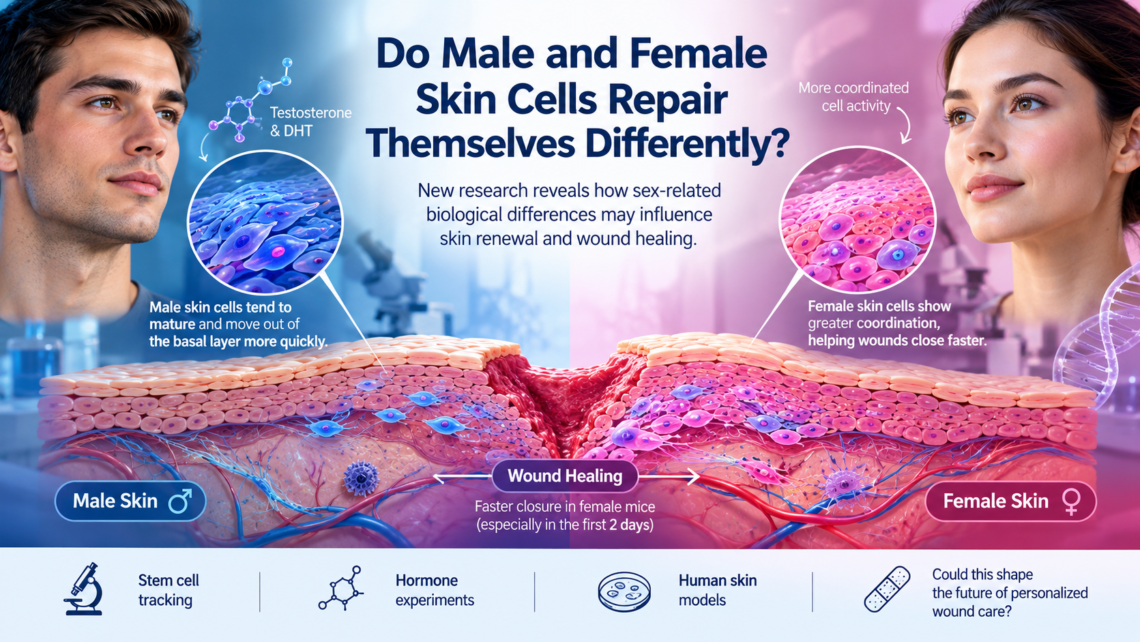
Yes, emerging research suggests that male and female skin cells can behave differently during skin renewal and wound healing. A study published in Nature in October 2026 found that skin stem cells in female mice coordinated their activity more closely than those in male mice. This difference was associated with faster wound closure in female mice, particularly during the first few days after injury.
The findings could help researchers understand why wounds heal differently between individuals and whether future treatments should account for biological sex. However, the study does not establish that wounds always heal faster in women than in men.
What did the researchers discover?

Female skin cells showed greater coordination
The researchers observed that daughter cells produced by the same parent cell tended to divide or mature in a more coordinated pattern in female mice. This organized activity helps maintain the skin’s outer protective layer.

Male hormones influenced cell maturation
Experiments indicated that androgens, including testosterone and its active form dihydrotestosterone (DHT), encouraged skin cells to differentiate and move out of the basal layer. Removing the main source of testosterone in male mice shifted cell behaviour toward a more female-like pattern.

Female mice healed experimental wounds faster
After researchers created small skin wounds, female mice showed more active cell proliferation around the wound and faster closure, especially during the first two days. The difference became smaller as healing progressed.
How was the study conducted?
The research team, involving scientists from the Université libre de Bruxelles and the University of Cambridge, used several methods to investigate skin renewal:
- Long-term cell tracking: Individual skin stem cells and their descendants were monitored in living mice over five months.
- Microscopy and cell analysis: Researchers examined how cells divided, matured and moved from the basal layer toward the skin surface.
- Hormone experiments: They studied mice after testosterone deprivation and investigated the effects of DHT.
- Human skin models: Laboratory-grown human skin tissue was used to test whether DHT could also influence human skin-cell differentiation.
The study was published in Nature on October 14, 2026, under the title Sexual dimorphism in epidermal stem cell dynamics.
Could this change future wound-care treatments?
Potentially, yes. The discovery offers several promising research directions.
Personalized wound care
Future studies could investigate whether biological sex and hormone levels help explain differences in recovery after surgery, burns or other skin injuries.
Chronic wound research
Scientists could examine whether altered stem-cell coordination contributes to wounds that heal slowly, including some diabetic wounds.
Hormone-related therapies
Researchers may explore how hormonal signals influence skin regeneration. However, manipulating testosterone or estrogen is not an established treatment for speeding up wound healing.
These are potential applications, not treatments validated by this study. Human clinical research is needed before the findings can guide routine medical care.
Important limitations
The central wound-healing experiments were conducted in mice, and laboratory-grown human skin models provided only partial evidence of relevance to people. Human wound healing also depends on age, nutrition, blood circulation, infection, underlying diseases, medications and the location and severity of the injury.
Therefore, it would be misleading to conclude that all women heal faster than all men or that one sex has universally healthier skin.
Conclusion
This October 2026 discovery reveals that skin repair is influenced not only by individual cells but also by how their activities are coordinated. Sex hormones appear to help regulate this process, affecting skin renewal and early wound closure in mice.
The next major challenge is to determine whether these mechanisms have a meaningful effect on human wound healing. If confirmed, the findings could help researchers develop more personalized approaches to treating skin injuries and chronic wounds.